
Electrical problem at home? Talk to a licensed Newnan electrician.
Free estimates · GA License EN216120 · Mon–Fri 8–5
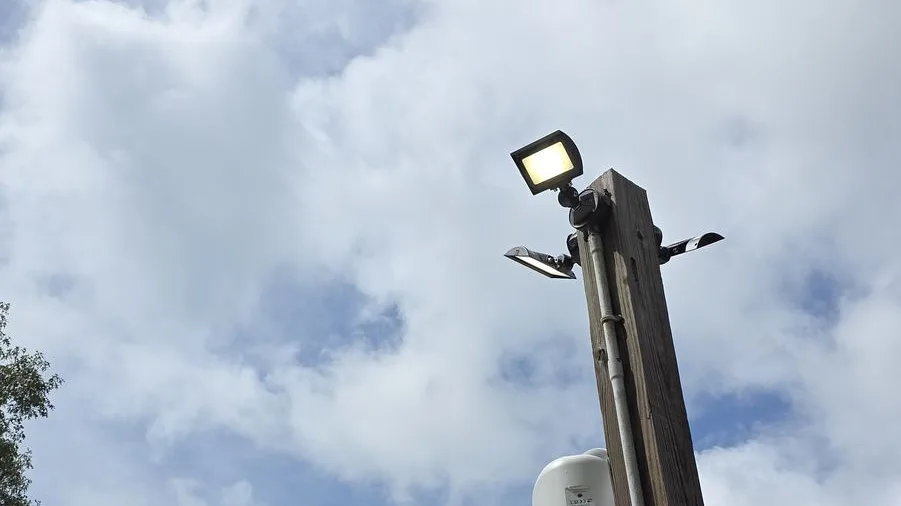
Dark driveways, shadowed side yards, and poorly lit porches are common around Newnan and Coweta County, especially on larger lots in Sharpsburg, Senoia, and Peachtree City. Good outdoor flood lighting is not just about looks. It helps you see who is at the door, walk safely to the car at night, and discourage unwanted activity around the garage and backyard. Here is what homeowners should know before adding or upgrading exterior flood lights, including how bright flood lights should be.
Where Flood Lights Make the Biggest Difference
Most homes benefit from lighting in a few high-value spots rather than blasting the whole yard with one bright fixture:
- Driveway and front walk. Even light along the path to the front door reduces trips and makes guests feel welcome.
- Garage and side entries. These are the places people approach first after dark, and they are common blind spots on older homes.
- Back patio and deck. Useful for evening gatherings and for seeing steps, grill areas, and outdoor outlets.
- Detached sheds or workshops. A dedicated flood on a motion sensor is often enough without lighting the whole property.
Aim fixtures so light falls on the ground and building surfaces, not into a neighbor’s windows. That keeps the yard usable and avoids complaints from nearby homes.
LED Flood Lights vs. Older Halogen Fixtures
Many Newnan homes still have halogen flood lights that run hot, use a lot of power, and burn out often. Modern LED floods are a better fit for most properties:
- Lower energy use and cooler operation
- Longer lamp life, so fewer ladder trips
- Options for soft white or daylight color temperatures
- Many models work with motion sensors and dusk-to-dawn photocells
If you are already planning interior upgrades, our team can coordinate outdoor floods with LED and recessed lighting installation in Newnan, GA so the whole house feels consistent.
How Bright Should Flood Lights Be?
Flood light brightness is measured in lumens, not watts. More is not always better: a light that is too bright for the space creates glare, deep shadows and complaints from the neighbors. As a general guide:
- Porches, entries and side doors: roughly 700 to 1,300 lumens is usually plenty.
- Driveways, garages and backyards: about 1,500 to 3,000 lumens covers most areas.
- Large yards, barns and sport courts: 3,000 lumens or more, often from several fixtures instead of one very bright light.
Mounting height and aim matter as much as the lumen rating. Mount floods high, angle them down toward the area you want lit, and choose a color temperature around 3000K to 4000K for a clear, natural look. If you are not sure how bright your flood lights should be, our exterior flood light installation team can recommend fixtures and placement for your property.
Motion Sensors, Photocells, and Timers
Controls matter as much as the fixture. A motion sensor turns lights on when someone walks up the driveway, then shuts them off so you are not lighting empty space all night. A photocell (dusk-to-dawn) keeps a low level of light on after sunset. Some homeowners want both: a soft always-on porch light plus a brighter flood that only fires on motion.
Sensors need a clear view of the approach path. Mounting them too high, aiming them at swaying trees, or placing them where car headlights constantly trigger them leads to false trips. We adjust height, angle, and sensitivity so the light behaves the way you expect.
Power, Weatherproofing, and Outdoor Outlets
Exterior lighting should be on weatherproof fixtures and covers rated for outdoor use, with sealed connections that hold up to Georgia heat, rain, and pollen. If the circuit is shared with other loads, adding several floods can trip a breaker or leave you with dim, underpowered lights.
Many projects also need a new outdoor receptacle or a dedicated run for landscape lighting transformers. That work falls under new receptacles and wiring in Newnan, GA, and it is often easier to do at the same time as the flood lights so you are not opening the same walls twice.
When DIY Outdoor Lighting Becomes a Problem
Plug-in solar stakes are fine for accents, but hardwired floods involve outdoor-rated cable, proper boxes, GFCI protection where required, and correct breaker sizing. Common DIY issues we see around Coweta County include:
- Fixtures wired without a weatherproof box or with open splices in the attic soffit
- Lights that flicker or die when it rains because water is getting into the connections
- Overloaded garage circuits that also feed freezers, tools, and EV chargers
- Switches or sensors that do not match the LED load and chatter or fail early
If an outdoor light is already acting up, start with our exterior flood light installation page for Newnan, GA, or call for troubleshooting before the problem spreads to the rest of the circuit.
Planning Lights for Newnan, Peachtree City, and Nearby Towns
Lot size and tree cover change what works. A compact Newnan subdivision lot may need two well-aimed floods and a porch light. A wooded Sharpsburg or Senoia property often needs more coverage along the driveway and side paths. Peachtree City and Tyrone homes with longer front setbacks benefit from layered lighting so the walkway stays bright without lighting up the whole street.
Shocking Electric Solutions, Inc. designs and installs outdoor lighting that fits the house you have, not a one-size layout from a big-box aisle.
Call Shocking Electric Solutions, Inc.
Ready for brighter, safer outdoor lighting? Call Shocking Electric Solutions, Inc. at (678) 552-9399 or text (470) 516-7261 to schedule a visit. Many customers prefer texting. We are based at 1002 Highway 16 W, Suite A, Newnan, GA 30263, and serve Newnan and communities within about 40 miles, including Peachtree City, Tyrone, Sharpsburg, Senoia, Carrollton, and Riverdale. Learn more about our licensed electricians in Newnan, GA.