
Electrical problem at home? Talk to a licensed Newnan electrician.
Free estimates · GA License EN216120 · Mon–Fri 8–5
A dark side yard, unlit back door, or shadowed parking area can make a property feel exposed long before there is an actual emergency. Outdoor security lighting installation gives you practical visibility where it matters most – at entrances, walkways, driveways, gates, and work areas – without turning your home into a brightly lit nuisance for the neighbors.
The right setup does more than add a fixture above the garage. It uses the correct light output, placement, controls, and weather-rated wiring to make people, steps, locks, and unexpected movement easier to see. For property owners in Newnan and nearby communities, the goal is straightforward: improve safety, deter unwanted activity, and make sure the electrical work is done right the first time.
Start Outdoor Security Lighting Installation With a Plan
Security lighting works best when it solves a specific visibility problem. Before choosing fixtures, walk the property after dark and notice where the light drops off. You may find that the front porch is bright but the route from the driveway to the door is not, or that a rear entry is visible from inside the home but hidden from the yard.
Focus first on areas where people enter, leave, park, walk, or work. Residential priorities often include front and back doors, garage doors, side gates, stairs, decks, pool areas, and detached buildings. Businesses may need attention around customer entrances, employee doors, dumpsters, loading areas, parking lots, and exterior service equipment.
Avoid treating every dark spot as a reason for a powerful floodlight. Too much glare can create deep shadows outside the beam, make it harder for drivers or pedestrians to see, and shine directly into neighboring windows. A layered design is usually more effective: focused lighting at doors and gates, pathway lighting where people walk, and broader coverage where vehicles park or activity needs to be visible.
Choose the fixture for the job
LED fixtures are the practical choice for most exterior security applications. They use less energy than older halogen or incandescent options, last longer, and provide immediate full brightness in cooler weather. Fixture brightness is measured in lumens, but more lumens are not automatically better.
A modestly bright fixture may be enough for a porch or side door, especially when it is mounted close to the entry. A driveway, large backyard, commercial rear entrance, or parking area may require higher-output fixtures placed strategically to distribute light evenly. Color temperature matters, too. Warm-white lighting can feel more comfortable around a home, while neutral or cooler white can improve contrast for cameras and task areas. The right choice depends on the property, surrounding homes, and the area you need to see.
Every fixture installed outdoors must be rated for its location. A fixture under a covered porch does not face the same moisture exposure as one mounted on an open wall, tree-line pole, or soffit. Wet-location ratings, corrosion-resistant materials, proper mounting, and sealed connections help prevent early fixture failure and electrical hazards.
Controls That Improve Security Without Wasting Power
Leaving every exterior light on from dusk to dawn may be appropriate for some commercial properties, but it is not the only option. Good controls make lighting more useful and reduce unnecessary energy use.
Photocells turn lights on when daylight fades and off after sunrise. They are a dependable option for areas that should remain consistently lit, such as a business entrance, address sign, or long driveway. Timers add more control, allowing lights to operate during the evening hours when activity is most likely and shut off later at night.
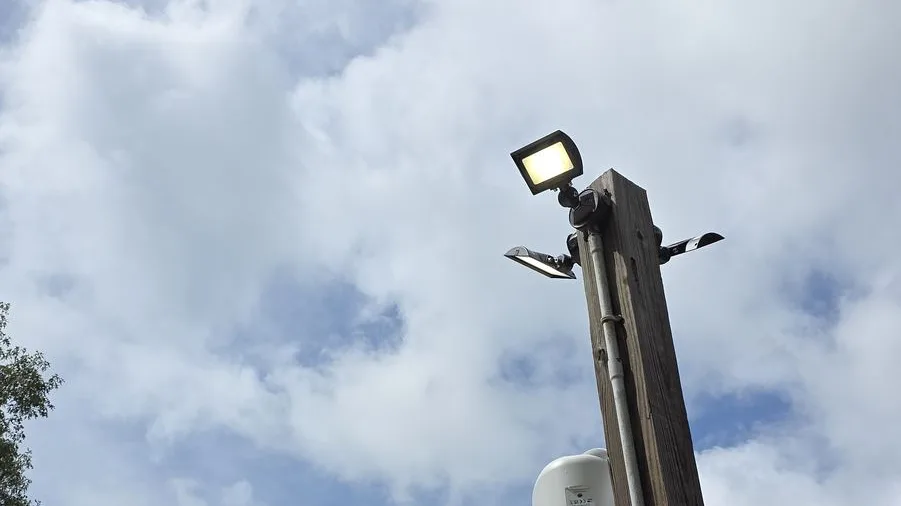
Motion sensors are useful at side yards, rear doors, garages, and other locations that do not need constant lighting. They can alert occupants to movement and make a dark area visible quickly. Sensor placement is critical. A poorly aimed sensor may activate every time a car passes, a pet moves through the yard, or branches sway in the wind. It may also fail to detect someone approaching from the direction that matters most.
Many property owners prefer a combination of controls: low-level dusk-to-dawn lighting at the main entrance and motion-activated lighting at secondary access points. For business properties, a scheduled lighting system with manual override capabilities can provide dependable coverage while accommodating changing operating hours.
Wiring Is Where Safety and Reliability Are Decided
The fixture is the visible part of the project. The electrical connections behind it determine whether the installation remains safe through rain, humidity, heat, storms, and daily use.
Outdoor circuits require appropriate protection and materials. Depending on the location and existing electrical system, that can include weatherproof boxes and covers, properly rated cable or conduit, sealed fittings, GFCI protection, and correct grounding. The circuit must also be sized and connected correctly for the load. Adding several high-output fixtures to an overloaded circuit can lead to nuisance tripping, unreliable performance, or a more serious electrical issue.
A common mistake is tapping into an existing exterior light or receptacle without checking what else is already on that circuit. Older homes may have exterior devices tied to areas that are already heavily used indoors. Commercial properties can have more complex systems, including lighting controls, dedicated circuits, and equipment that must remain accessible and clearly identified.
Professional installation also addresses how the wiring gets from the panel or source location to the fixture. Exposed cable, improvised splices, damaged conduit, or connections hidden where they cannot be serviced are not lasting solutions. Clean, code-compliant workmanship protects the property and makes future repairs or upgrades far easier.
When low-voltage lighting makes sense
Low-voltage landscape lighting can be a good addition around walkways, landscaping, retaining walls, and certain outdoor living spaces. It creates a welcoming path of visibility and can reduce the need for powerful lights near the house. However, it is not a replacement for properly installed line-voltage security lighting at critical entries, parking areas, or large open spaces.
If you want both, use each system for its strength. Low-voltage lighting can guide people safely through the property, while dedicated security fixtures provide clear illumination at doors, gates, and vulnerable areas.
Placement Details That Make a Noticeable Difference
Mount security lights high enough that they are difficult to tamper with, but not so high that the light misses the area below. A fixture above a garage, for example, should be aimed to cover the drive and the approach to the home rather than sending most of its output into the street or tree canopy.
At entry doors, position lights so they illuminate a visitor’s face without shining directly into the eyes of someone at the door. This is especially useful for doorbell cameras and other security cameras. Cameras need balanced lighting, not a bright hotspot with a completely dark background.
Be considerate of property lines. Light trespass can create tension with neighbors and may violate local rules in certain commercial or multifamily settings. Adjustable fixture heads, shielding, and careful aiming keep light on your property where it belongs.
For commercial sites, check light levels from the perspective of employees and customers. The walk from a vehicle to the door should be visible, addresses and signs should be easy to find, and service routes should not leave staff walking through blind spots after hours. Lighting can also support safer maintenance work around electrical equipment, HVAC units, and loading areas.
Signs Your Existing Exterior Lighting Needs Attention
Do not wait for complete failure if your outdoor lights are already acting unpredictably. Flickering, repeated breaker trips, fixtures that work only sometimes, water inside the lens, scorched wiring, cracked boxes, or a motion sensor that will not reset all deserve attention. A bulb change will not fix a loose connection, failing circuit, damaged cable, or moisture intrusion.
Older fixtures may also be using far more power than necessary while providing poor light coverage. Replacing them with properly placed LEDs and modern controls can improve visibility and reduce operating costs at the same time.
If a breaker trips after rain, a fixture sparks, or you notice a burning odor, turn off the affected circuit if it is safe to do so and arrange electrical service promptly. Exterior electrical issues are exposed to moisture and weather, so they should not be treated as a minor inconvenience.
Get the Work Done for the Property You Have
Every property has different wiring conditions, building materials, lighting goals, and budget priorities. A new fixture may be a simple addition when there is a suitable existing circuit nearby. In other cases, the safer permanent fix involves a new circuit, upgraded protection, repaired exterior wiring, or a better location for the fixture.
Shocking Electric Solutions provides licensed, insured outdoor lighting work for homes in Newnan and surrounding communities, with upfront pricing, clean professional workmanship, and a two-year warranty on completed work. A qualified electrician can evaluate the existing system, recommend practical fixture locations, and install the wiring and controls needed for dependable operation.
A well-lit property should feel safer without feeling harsh. Start with the places people rely on after dark, choose controls that fit how the property is used, and have the electrical side handled before a small exterior lighting problem becomes an urgent one.
Outdoor Security Lighting in Coweta County
Many Coweta County properties, from wooded lots outside Newnan and Senoia to driveways in Sharpsburg, have dark corners that motion-activated floods or dusk-to-dawn fixtures handle well. Outdoor work also needs weather-rated boxes and GFCI protection. See our exterior flood lights service and our landscape lighting page.
Shocking Electric Solutions, Inc. is a licensed Georgia electrical contractor (license EN216120) at 1002 Highway 16 W, Suite A, Newnan, GA 30263. We serve Newnan, Coweta County, Senoia, Sharpsburg, Peachtree City, Carrollton, Riverdale and south Atlanta, and our work is backed by a 2-year warranty. Office hours are Monday through Friday, 8 AM to 5 PM, and we can also help with electrical emergencies.
Ready to get it fixed? Call (678) 552-9399, text (470) 516-7261, or book online.