
Electrical problem at home? Talk to a licensed Newnan electrician.
Free estimates · GA License EN216120 · Mon–Fri 8–5
A dark kitchen corner or a living room with one tired ceiling fixture can make a good home feel unfinished. Recessed lights fix that, but only when the layout is planned first. These recessed lighting layout tips cover spacing, placement, brightness and controls, plus the wiring questions a licensed electrician should answer before any holes are cut.
Recessed Lighting Layout Tips: Start With the Room
Every ceiling has a different story behind it. A licensed electrician should evaluate the space, locate the power source, confirm circuit capacity, and identify anything that could affect a safe installation.
The layout should follow how the room is used. A kitchen needs light on the counters, a living room needs even ambient light that works around a fan or TV, and a hallway needs clear light without a crowded ceiling.
Spacing and Placement
- Space lights evenly: a common starting point is to divide the ceiling height by two to estimate the spacing between lights, so an 8-foot ceiling gets lights about 4 feet apart. Adjust for beam angle and how bright the fixtures are.
- Keep lights off the walls: placing the first row roughly 2 to 3 feet from the walls avoids harsh scalloping and lights the room instead of the paint.
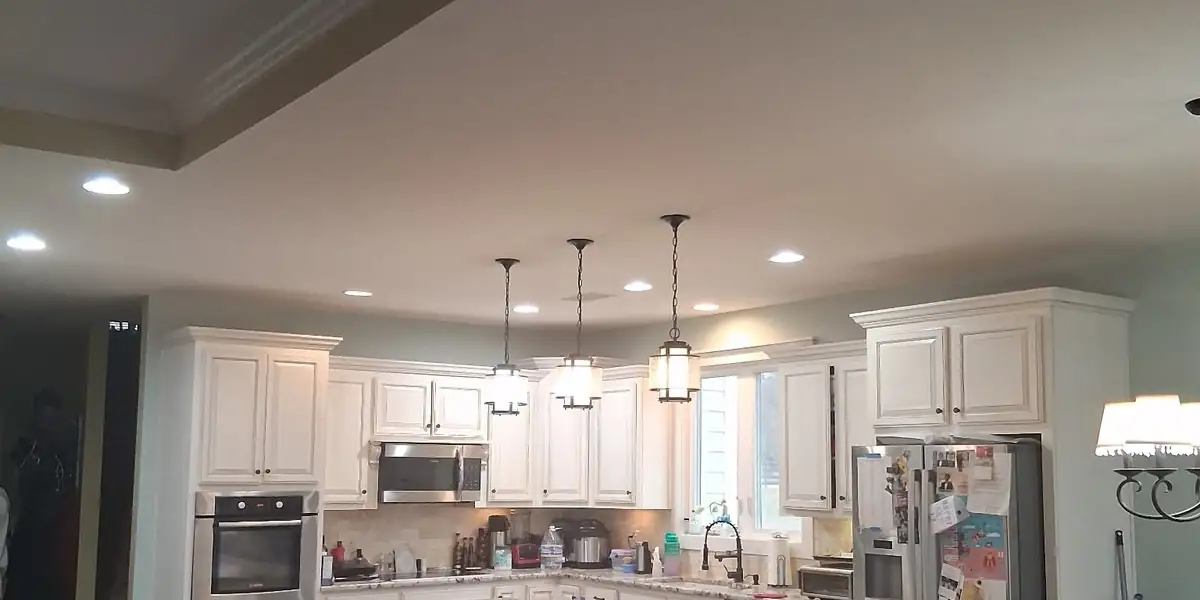
- Light the work, not the back of your head: in kitchens, place lights over the front edge of the counters so you are not standing in your own shadow.
- Work around what is already there: ceiling fans, beams, cabinets, smoke detectors, ductwork and framing all affect where a light can go.
- Use zones: separate switching for the kitchen, island and dining area, or for the seating area and the walkway, makes one layout work for different tasks.
Existing Fixture Replacement vs. New Recessed Lights
Replacing an existing ceiling light with a recessed fixture can sometimes be simpler because power is already at the location. But one recessed light rarely provides the same room coverage as a central fixture. Homeowners often decide to install four, six, or more lights to eliminate shadows and create even illumination.
That is where planning matters. In a kitchen, lights should support countertop tasks without casting shadows from the person standing at the counter. In a living room, the layout may need to work around a fan, fireplace, or artwork. In a hallway, spacing must provide clear, even light without making the ceiling look crowded.
A professional electrician can help turn the room’s purpose into a practical layout before holes are cut.
Choosing the Right Recessed Lights for Your Space
Most homeowners choose integrated LED recessed lights because they are slim, energy-efficient, and available in several color temperatures. Warm white light can make living areas feel comfortable, while neutral or cooler light is often preferred for kitchens, garages, workspaces, and retail areas.
Brightness matters as much as color. A room with dark cabinets, tall ceilings, or limited natural light may need a different layout than a bright room with white walls. Dimmable lights offer flexibility, but the dimmer and fixtures must be compatible. Buying mismatched components can lead to flickering, buzzing, or a dimming range that feels disappointing.
There is also a design trade-off to consider. Recessed lights provide clean, broad light, but they do not have to replace every decorative fixture. Many rooms work best with recessed lighting for general illumination plus pendants, sconces, or a ceiling fan for character and focused light.
What Affects the Installation
- Ceiling access: An open attic above the room gives the electrician a clear route for wiring. Finished ceilings, second stories, and low-slope roofs can require more careful work and more time.
- Number and placement of lights: A balanced layout matters. Spacing lights around cabinets, ceiling fans, beams, televisions, and work areas takes planning, and a larger layout requires more wiring and fixtures.
- Existing wiring and circuit capacity: A newer, properly wired home may have an available circuit or an appropriate lighting circuit to extend. Older wiring, overloaded circuits, or a crowded panel can add necessary corrective work.
- Switches and dimmers: Adding a dimmer, creating separate lighting zones, or installing three-way switches at multiple entrances increases convenience but also adds wiring and switch work.
- Fixture type and rating: Standard LED canless fixtures are often a practical choice, and adjustable, decorative, wet-rated, high-ceiling, or smart-compatible fixtures are available for special spaces. Fixtures installed near insulation must also be properly rated for that location.
- Repairs and code updates: If access holes, drywall patching, or corrections to unsafe wiring are needed, those items should be clearly explained before work begins.
Wiring, Panels, and Safety Should Be Part of the Conversation
LED recessed lights use much less energy than older incandescent fixtures, but the electrical work still needs to be done correctly. Each connection must be enclosed in an approved junction box, wiring must be supported and protected, and the circuit must be sized and connected appropriately.
If an electrician finds aluminum branch wiring, damaged insulation, improperly spliced wires, repeated breaker trips, or an overloaded panel, that condition deserves attention before new lighting is added. Adding fixtures to a problem circuit is a short-term patch, not a solution.
This is also why who does the work matters. The visible result might be a clean new light either way, but the work behind the ceiling is what determines whether the installation is code-compliant and dependable. For a property owner, that difference matters at inspection time, during a sale, and whenever the circuit is used every day.
Plan Several Lights at Once
Combining recessed lights into one planned project is usually more efficient. The electrician can map the layout once, pull wire along a single route, install switches and dimmers together, and complete testing in one visit.
If you are already renovating a kitchen, finishing a basement, replacing a ceiling fan, or opening walls for another project, it is an especially good time to plan lighting. Open framing provides easier access than retrofitting a fully finished room later.
There are still times to phase the work. If a panel upgrade, renovation, or commercial tenant build-out is planned in stages, it may make sense to complete the electrical infrastructure first and add fixtures as each area is finished. Honest recommendations should fit the project, not force unnecessary work into one appointment.
Questions to Ask Before Work Begins
A clear estimate should tell you what is included: the fixtures, switches or dimmers, wiring, cutting and installing the lights, testing, any permit requirements, and any drywall repair. If the plan assumes attic access or an available circuit, make sure that is stated.
It is also reasonable to ask what happens if the electrician discovers an issue hidden in the ceiling. Some conditions cannot be confirmed until work begins, especially in older homes. The important part is clear communication before additional work is performed.
For commercial spaces, ask how the work will be scheduled to minimize disruption, whether lights will be placed around ceiling grids or equipment, and whether emergency or exit lighting may be affected. A small lighting upgrade can have larger operational considerations in an occupied business.
Recessed Lighting Around Newnan
Shocking Electric Solutions can look at your space, sketch a layout that fits how you use the room, and complete the work safely with a two-year workmanship warranty and a free estimate. See our LED and recessed lighting installation in Newnan, GA, or our lighting installation page for fixtures, outdoor and landscape lighting.
Shocking Electric Solutions, Inc. is a licensed Georgia electrical contractor (license EN216120) at 1002 Highway 16 W, Suite A, Newnan, GA 30263. We serve Newnan, Coweta County, Senoia, Sharpsburg, Peachtree City, Carrollton, Riverdale and south Atlanta, and our work is backed by a 2-year warranty. Office hours are Monday through Friday, 8 AM to 5 PM, and we can also help with electrical emergencies.
Ready to plan your lighting? Call (678) 552-9399, text (470) 516-7261, or book online.