
Electrical problem at home? Talk to a licensed Newnan electrician.
Free estimates · GA License EN216120 · Mon–Fri 8–5
A dead outlet can stop a workday, leave a refrigerator without power, or make you wonder whether there is a larger wiring problem behind the wall. If you are asking how to test a dead outlet, start with the checks that are safe for a property owner – and know the warning signs that mean you should stop and call an electrician.
The outlet itself may not be the source of the problem. A tripped breaker, an upstream GFCI outlet, a loose wire connection, or a damaged receptacle can all cause one outlet to go dead. The goal is not to force power back on. It is to identify whether this is a simple reset or an electrical repair that needs to be done right the first time.
Start With Safety Before Testing a Dead Outlet
Do not test a dead outlet if you see scorch marks, melted plastic, smoke staining, water around the outlet, loose or exposed wiring, or a cracked cover plate. Turn off the breaker if you can identify it safely, keep people away from the area, and arrange professional service. A burning smell or a warm outlet is especially urgent. Those symptoms can point to a loose connection that is generating heat inside the box or wall.
Also stop if a breaker immediately trips again after being reset. Repeated tripping is not an inconvenience to work around. It is a protective device responding to a possible overload, short circuit, ground fault, or equipment failure.
For basic troubleshooting, keep your hands dry, stand on a dry floor, and do not insert metal objects into an outlet. Never remove an outlet cover or pull the receptacle from the wall to inspect wiring unless you are qualified to work on electrical systems. What looks like a simple dead receptacle can involve energized wiring in the box.
How to Test a Dead Outlet Step by Step
Confirm that the device is not the problem
Before focusing on the outlet, test the lamp, charger, tool, or appliance in a known working outlet. A failed phone charger or a switched-off power strip can look exactly like a dead receptacle.
Then plug a simple device, such as a lamp that you know works, into both sockets of the suspected outlet. Test the top and bottom receptacles separately. In some rooms, one half of an outlet may be controlled by a wall switch while the other half remains powered all the time.
Check nearby wall switches as well. A switch may control that outlet, especially in living rooms, bedrooms, garages, and older homes where a switched outlet was used for a floor lamp.
Check for a tripped breaker
Go to your electrical panel and look for a breaker that is in the middle position or appears slightly out of line with the others. A tripped breaker does not always look fully “off.” To reset it correctly, move it firmly all the way to OFF first, then move it back to ON.
Return to the outlet and test it again with your known working lamp or device. If power returns and the breaker stays on, an overload may have caused the trip. Think about what was plugged in when the outlet stopped working. Space heaters, hair tools, microwaves, window air conditioners, power tools, and several devices on one circuit can overload it.
If the breaker trips again, leave it off. Do not keep resetting it. That is the point where a licensed electrician should locate the cause instead of allowing a hidden fault to continue.
Reset nearby GFCI outlets
A GFCI outlet is usually identified by TEST and RESET buttons. These outlets are common in bathrooms, kitchens, garages, laundry areas, unfinished basements, exterior locations, and commercial spaces. One GFCI can protect several regular outlets downstream, sometimes in another room.
Look for GFCI outlets nearby and in adjacent spaces. For example, a dead garage outlet may be protected by a GFCI in the garage, laundry room, bathroom, exterior wall, or utility area. Press RESET firmly on any GFCI that has tripped, then retest the dead outlet.
If the RESET button will not stay in, the GFCI may not have power, may have failed, or may be detecting a fault. Do not bypass it or replace it with a standard outlet. GFCI protection is designed to reduce shock hazards in locations where moisture is more likely.
Use a plug-in outlet tester if appropriate
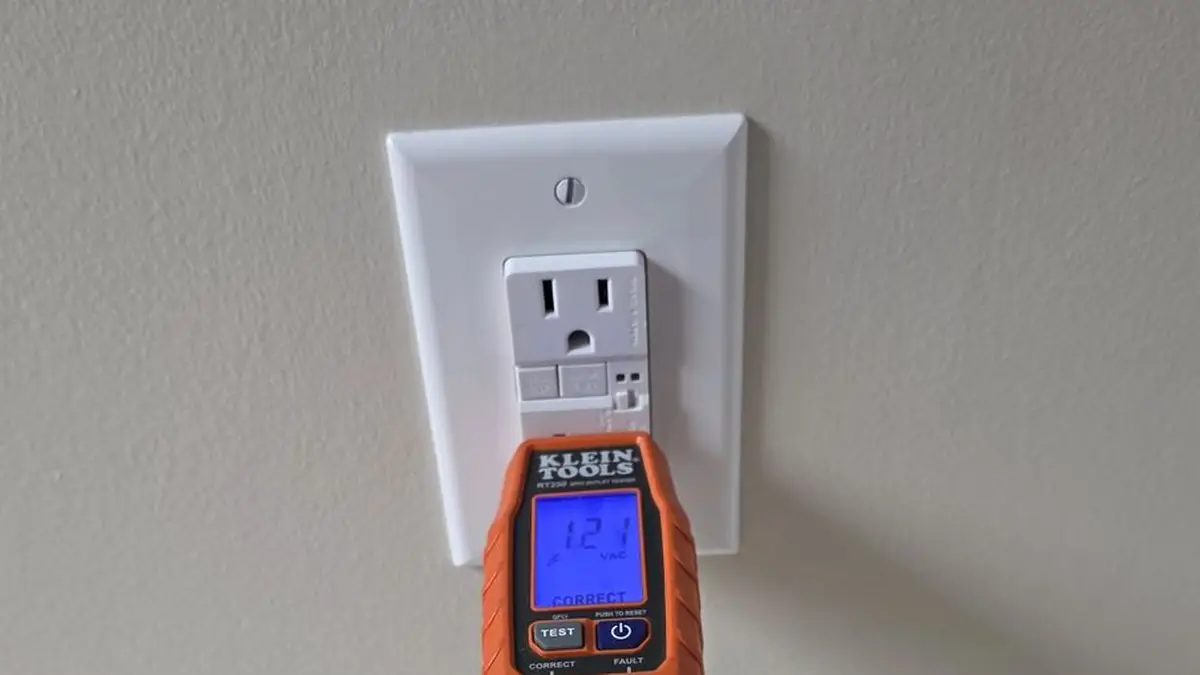
A basic plug-in receptacle tester can provide a quick indication of whether an outlet has power and whether common wiring issues may be present. Plug the tester into the outlet and compare the light pattern with the chart printed on the tester.
These tools are useful for a first check, but they are not a full electrical diagnosis. They may not detect every dangerous wiring condition, and they cannot tell you why a connection failed. If the tester reports an open ground, open neutral, reversed wiring, or no power, treat that result as a reason to schedule a professional inspection rather than a DIY repair.
A non-contact voltage tester can also be helpful around cords and accessible wiring, but it should not be the only tool used to declare an outlet safe. False readings and missed readings are possible. A qualified electrician uses proper testing equipment and verifies results at the source.
Why One Outlet Can Lose Power While Others Work
When just one outlet is dead, the problem is often a failed receptacle or a loose connection at that outlet or another outlet earlier on the same circuit. Electricity may pass from one receptacle to the next, so a poor connection in one box can interrupt power to outlets farther down the line.
This is more than a convenience issue. Loose connections can arc, build heat, and damage wiring or insulation. Older outlets, heavily used kitchen and garage circuits, backstabbed connections, and outlets that have been loosened by frequent plugging and unplugging are common trouble spots.
If several outlets, lights, or rooms have lost power, the issue may involve a breaker, GFCI device, damaged circuit wiring, panel connection, or utility-related outage. Check whether neighbors have power and whether other areas of your building are affected, but do not open the electrical panel or attempt repairs inside it.
For rental homes and commercial properties, a dead outlet can also affect required equipment, tenant operations, or code compliance. Property managers should document the location, what was plugged in, whether a breaker or GFCI tripped, and any visible damage. That information helps an electrician troubleshoot faster and reduces disruption.
When a Dead Outlet Needs Immediate Service
Some outlet failures should not wait for a convenient appointment. Call for prompt electrical service if the outlet is warm, buzzing, sparking, discolored, loose in the wall, or accompanied by a burning odor. The same applies if power fails after water exposure, a breaker will not stay reset, or lights flicker when equipment is plugged into the circuit.
Avoid using extension cords as a long-term workaround for a dead outlet. An extension cord may temporarily power a small device, but running cords under rugs, across walkways, through doorways, or for high-demand appliances creates additional fire and trip hazards. If you need power in a location regularly, the lasting solution may be outlet repair, a new dedicated circuit, or an added receptacle installed to code.
Shocking Electric Solutions helps homeowners, property managers, and businesses in Newnan and nearby communities identify the real cause of outlet failures and complete repairs with clean, professional workmanship. A proper diagnosis can reveal whether the fix is a failed receptacle, a GFCI issue, damaged wiring, or a circuit problem that needs more attention.
A Safer Next Step
Testing a dead outlet can rule out a switched outlet, a tripped breaker, or a resettable GFCI. Once those checks do not restore power, resist the temptation to take the outlet apart yourself. A dead outlet is often the first visible sign of a connection problem that deserves a careful, code-compliant repair – especially when your home and peace of mind depend on it.
Dead Outlet Help in Newnan
If you have checked the breakers and every GFCI in your Newnan, Senoia or Sharpsburg home and the outlet is still dead, the cause is often a loose connection upstream. A licensed electrician can find it safely. See our outlet not working page and our outlet and GFCI services.
Shocking Electric Solutions, Inc. is a licensed Georgia electrical contractor (license EN216120) at 1002 Highway 16 W, Suite A, Newnan, GA 30263. We serve Newnan, Coweta County, Senoia, Sharpsburg, Peachtree City, Carrollton, Riverdale and south Atlanta, and our work is backed by a 2-year warranty. Office hours are Monday through Friday, 8 AM to 5 PM, and we can also help with electrical emergencies.
Ready to get it fixed? Call (678) 552-9399, text (470) 516-7261, or book online.
Still not sure what is causing the problem? Our electrical troubleshooting and repair in Newnan, GA service finds the real cause and fixes it safely. See also our page on outlet not working.